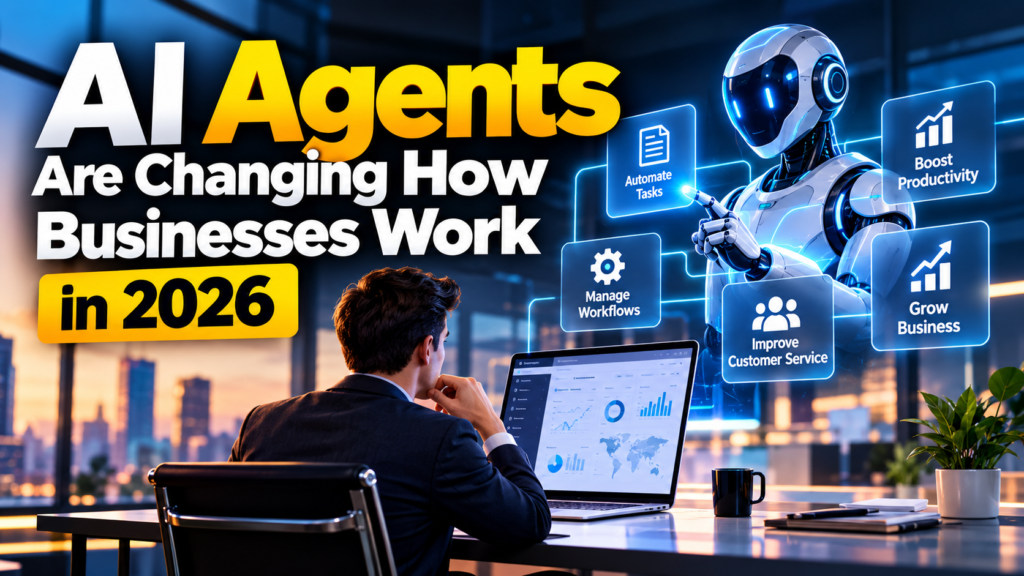
AI Agents Are Changing How Businesses Work in 2026
AI is moving beyond chatbots as businesses increasingly use AI agents to automate complex workflows, improve productivity and handle tasks with less human intervention.
AI Is Moving From Answers to Action
Artificial intelligence is entering a new phase in which software can do more than generate answers. AI agents are increasingly being designed to understand goals, access information, use digital tools and complete multiple steps with limited human intervention.
The shift is important because traditional AI assistants generally wait for a user to provide a prompt and then return an answer. Agentic systems are designed to take a broader objective and work through the tasks required to achieve it.
Google Cloud describes this transition as a move from individual prompts toward systems capable of orchestrating complex, end-to-end workflows. Google Cloud
Businesses Are Experimenting With AI Agents
Enterprise adoption of AI agents is growing, although organizations are at very different stages.
Gartner’s latest 2026 AI research says 17% of organizations have deployed AI agents today, while more than 60% expect to do so within two years. At the same time, Gartner warns that a significant share of agentic AI projects could be cancelled because of cost, unclear business value or inadequate risk controls. Gartner
Other industry research shows stronger adoption among companies already investing heavily in AI. A 2026 survey by LangChain of more than 1,300 professionals found that 57% of respondents reported having agents in production. Quality and reliability were among the major challenges reported by organizations. LangChain
The difference between these findings reflects an important point: AI-agent adoption is growing, but widespread production deployment is still developing.
From Chatbots to Agentic Workflows
The biggest change is the type of work AI can potentially handle.
A conventional chatbot might answer a customer’s question. An AI agent could potentially retrieve the customer’s information, check an order, identify the relevant policy, prepare a response and update another business system.
Similar approaches are being explored in software development, customer service, marketing, sales, cybersecurity and internal business operations.
Google Cloud’s 2026 research highlights the emergence of multi-agent workflows in which multiple AI systems can coordinate different parts of a larger process. blog.google
Why Companies Are Interested
The attraction is straightforward: businesses want to reduce repetitive work while allowing employees to spend more time on tasks requiring judgment, creativity and strategy.
Deloitte’s 2026 State of AI report found that worker access to AI increased significantly, while companies are increasingly looking at ways to move AI projects from experimentation toward production. The report also identifies AI skills and workforce readiness as major challenges. Deloitte United Kingdom
AI agents could therefore become another layer of business automation rather than simply another type of chatbot.
The Biggest Challenge Is Reliability
Greater autonomy also creates greater risk.
An AI agent that only produces text can be reviewed before someone acts on its recommendation. An agent connected to business systems may be capable of taking actions itself.
That makes errors, incorrect information, unauthorized actions and security failures more consequential.
Salesforce’s 2026 research on AI-agent development highlights the growing importance of deterministic guardrails, context engineering and reliable execution for enterprise systems. Salesforce
Organizations are consequently paying more attention to permissions, monitoring, testing and human oversight.
AI Governance Is Becoming Essential
As AI agents become more autonomous, companies need to know what an agent is doing, what information it can access and how much it costs.
Gartner’s October 2026 research says the AI conversation is increasingly shifting from capability toward accountability. It identifies AI observability, governance and cost controls as important infrastructure for organizations scaling agentic systems. Gartner
This could make AI governance an important part of the next stage of enterprise AI adoption.
The Shift From AI Assistance to AI Delegation
One of the clearest trends is the movement from asking AI for assistance to delegating complete tasks.
OpenAI’s 2026 enterprise research describes this transition as a move from assistance toward execution, with AI agents being used for increasingly substantive work across areas including legal, sales, recruiting and marketing. OpenAI
This does not mean humans are disappearing from these workflows. Instead, the role of employees may increasingly shift toward defining objectives, reviewing outputs, handling exceptions and making higher-level decisions.
What Comes Next?
The next stage of AI adoption may be less about creating a better chatbot and more about building reliable systems around AI.
Companies will need high-quality data, secure integrations, clear permissions, monitoring and employees who understand how to work with AI systems.
A recent UiPath survey of enterprise technology leaders found that data readiness, integration with existing workflows and governance were among the major challenges preventing organizations from scaling agentic AI. UiPath
For businesses, the question is therefore changing.
It is no longer simply “Can AI do this?”
The more important question is “Can AI do this reliably, securely and at a cost that makes business sense?”
As AI agents continue to develop, that question could determine which organizations successfully move from AI experimentation to real-world automation.
Read next

Breaking
Regional language voice search is growing faster than typed search

Technology
Offline-first apps are quietly winning in places with patchy networks
Technology
Open-source translation models are reaching languages commercial tools skipped

World